.webp)





What is the Acceptance and Commitment Therapy?
Acceptance and Commitment Therapy (ACT) is a term used in psychology. ACT is a therapeutic approach that has developed from cognitive behavioral therapy, a sub-spectrum of psychotherapy. It was developed by the psychiatrist Steven C. Hayes in the 1990s.
While “classic” cognitive behavioral therapy is about re-evaluating and reformulating negative thoughts or events, ACT is about accepting these unpleasant inner experiences and thoughts, not about changing them.
Unpleasant thoughts and feelings are not seen as harmful per se. Only our own negative evaluation of them can turn them into a burden. In ACT, thoughts and feelings are given space without giving them too much weight through negative evaluations. This can lead to increased acceptance, which in turn can have positive effects on well-being. Mindfulness- and acceptance-based elements in the form of small exercises and metaphors are used for this purpose. This part covers acceptance in ACT.
In the second part of the concept, commitment, one's own values are the central element.
Values are deeply rooted, personally important convictions, attitudes and ideals. They include, for example, loyalty or autonomy. Values are what you want for yourself and what is personally important to you in life. Values therefore provide direction and orientation.
Acting according to personal values leads to greater satisfaction and quality of life in the long term. Because it feels good to act in accordance with what is personally important in life and everyday life.
So as soon as there is clarity about personal values, ACT works out concrete steps on how to act in accordance with your own values in the short, medium and long term - without being held back by negative feelings or thoughts.
The six core processes of ACT
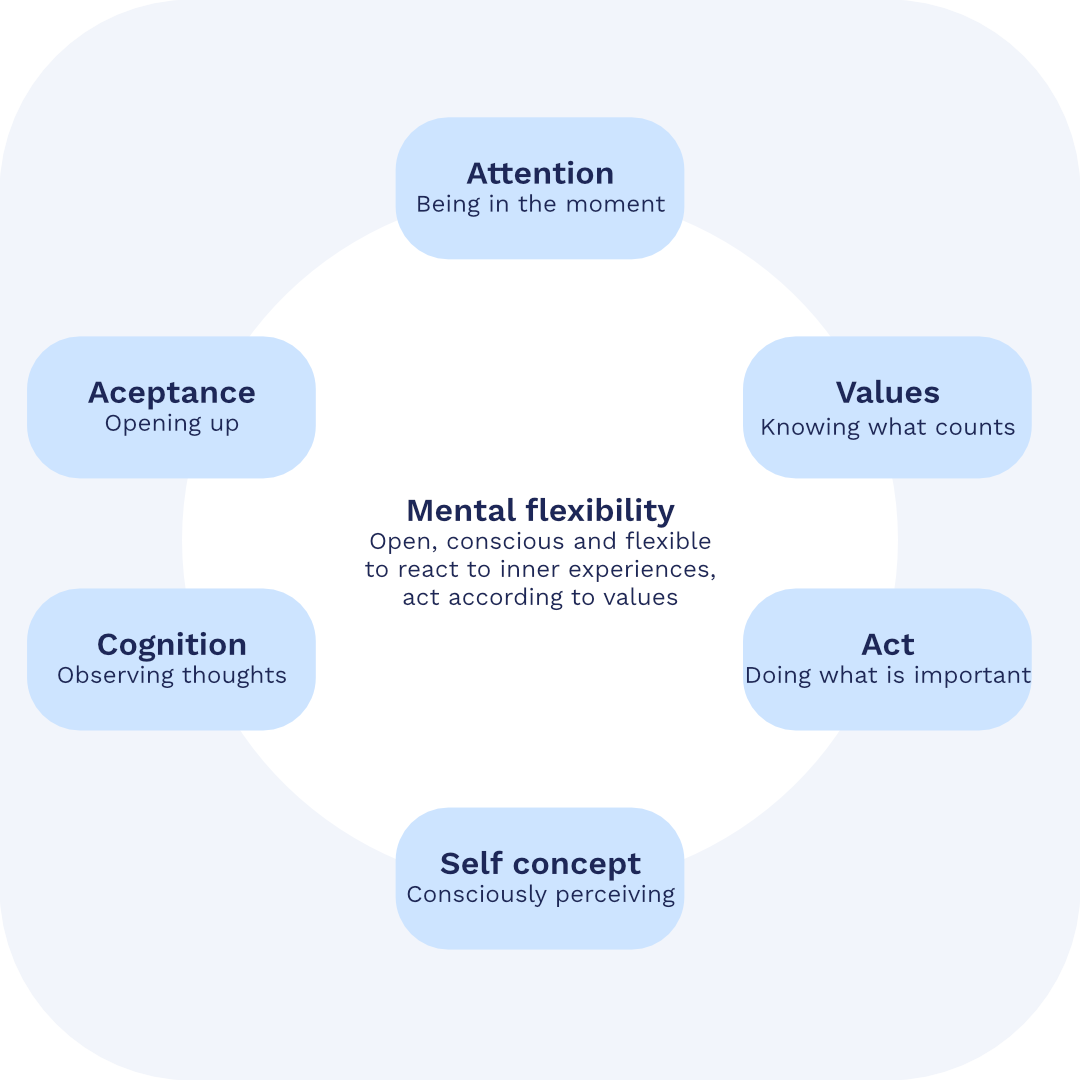
The overarching goal of ACT is psychological flexibility. Psychological flexibility describes the ability to react openly, consciously and flexibly to inner experiences. Inner experiences include thoughts, feelings, memories or physical sensations. At the same time, actions are in harmony with personal values.
The methods of ACT focus on six central processes: Attention, Acceptance, Cognition, Self-Concept, Values and Action. Psychological flexibility can be achieved in each of these:
- Awareness - being in the here and now without dwelling too much on the past or future.
- Acceptance - especially of thoughts and emotions, without avoiding them or distracting yourself from them. Psychological flexibility means allowing unpleasant thoughts and feelings to be there.
- Cognition - Flexibility here means so-called cognitive defusion, i.e. detaching oneself from thoughts, rules and patterns that are too rigid and stressful. Metaphors are often used for this.
- Self-concept - This is about accepting the many different roles you have in different contexts and being able to switch flexibly between them without getting stuck in one.
- Values - always being aware of your values, even when you are in a negative emotion.
- Action - the commitment to oneself to always act according to one's own values (even if only in small ways).